There is rarely a worse time for an air conditioner to quit than a hot North Texas afternoon. When your AC is not turning on, the cause can be as simple as a thermostat setting or as involved as a failed electrical part. The right move is to run through a short list of safe checks, which solve many cases in a few minutes, and to know when to stop and call a professional. This guide walks you through the checks in a sensible order, explains the most common causes, and shows when emergency service is the better choice.
| Quick Take Check the thermostat, the breaker, the air filter, and the condensate drain switch first. Reset a tripped breaker once only. If it trips again, stop and call a technician. Humming, clicking, burning smells, water, or ice are signs to call for service right away. |
Safety First
Air conditioners use high-voltage electricity and spinning parts, so a few ground rules apply. Do not remove electrical panels or touch wiring. Do not keep resetting a breaker that trips, because that is a sign of a real electrical problem. If you smell burning or see sparks or smoke, turn the system off at the thermostat and the breaker and call for help.
Quick Checks You Can Do Safely
Work through these checks in order. They are safe for most homeowners and fix a surprising number of no-start problems:
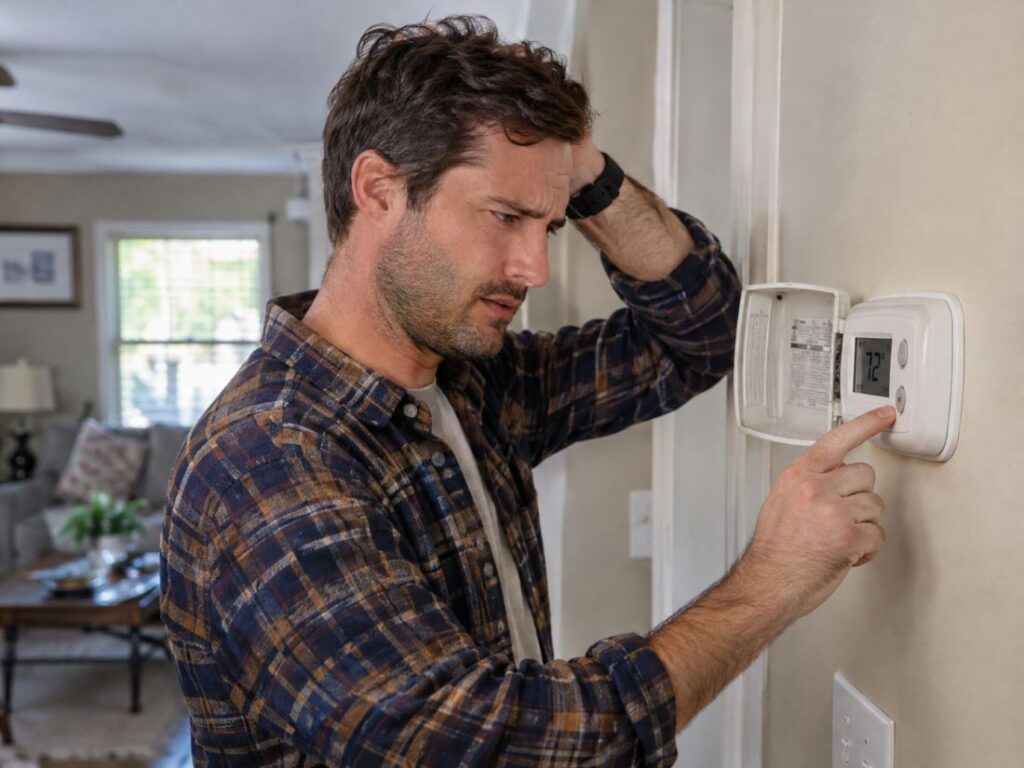
- Thermostat: Confirm it is set to Cool, the setpoint is below the room temperature, and the display is on. If the screen is blank, replace the batteries.
- Breaker: Look at the breakers for the air conditioner and the indoor unit. If one has tripped, reset it once.
- Outdoor disconnect: Many systems have a disconnect box near the outdoor unit. Make sure the switch is in the On position.
- Indoor unit switch: Look for a switch near the air handler or furnace that looks like a light switch, and make sure it is on.
- Air filter: A badly clogged filter can restrict airflow and cause the system to shut down. Replace it if it is dirty.
- Condensate drain: If there is water in the drain pan or around the indoor unit, a float switch may have shut the system off to prevent water damage.
If your thermostat looks dead or behaves oddly, our guide on thermostat not working covers that side of the problem in more detail.
Common Reasons an AC Will Not Start
If the quick checks do not help, the cause is usually inside the system. This table shows what each problem tends to look like and who should handle it:
| Cause | What You May Notice | DIY or Pro |
|---|---|---|
| Thermostat settings or dead batteries | Blank screen or wrong mode | DIY check |
| Tripped breaker | No power to the system, or it trips again | Reset once, then pro if it repeats |
| Clogged condensate drain and safety switch | Water near the indoor unit and the system is off | Pro recommended |
| Failed capacitor | Humming, clicking, or a fan that will not spin | Pro only |
| Worn contactor or relay | Clicking while the outdoor unit does not start | Pro only |
| Control board or transformer failure | No response at all from the system | Pro only |
| Frozen evaporator coil | Ice on the lines or weak airflow | Turn off the system, then pro |
Electrical parts such as capacitors, contactors, and control boards store energy or carry high voltage. That is why they should be tested and replaced by a licensed technician.
The Indoor Fan Runs, but the Outdoor Unit Does Not
A common pattern is air blowing from the vents while the outdoor unit stays silent. In that case the thermostat is working and the indoor fan has power, but the compressor or outdoor fan is not starting. Typical causes include a failed capacitor, a worn contactor, a tripped outdoor disconnect, or a problem with the compressor itself.
Do not keep running the system in this condition. Turn it off at the thermostat and schedule a repair so a small part failure does not become a larger one.
Why You Should Not Wait in Texas Heat
A house without cooling can get uncomfortable quickly, and it can become unsafe for infants, older adults, people with health conditions, and pets. If your AC will not start and the house is heating up, take steps to stay cool while you arrange service: close blinds on the sunny side, use fans, drink water, and move to the coolest part of the home or another location if needed.
When to Call for Emergency AC Repair
Some situations should not wait. Call for emergency AC repair if you notice any of the following:
- A breaker that trips again right after you reset it.
- Burning smells, buzzing, or loud clicking from the indoor or outdoor unit.
- Water leaking from the indoor unit or standing in the drain pan.
- Ice on the refrigerant lines or indoor coil.
- No response after you have checked the thermostat, breaker, filter, and drain.
A qualified AC repair visit finds the failed part, confirms that nothing else is damaged, and gets the system running safely again.
How to Prevent a No-Start Problem
Most no-start failures build up gradually. Changing the filter on schedule, keeping the condensate drain clear, and keeping plants and debris away from the outdoor unit all help. Scheduling AC maintenance before summer lets a technician test electrical parts such as the capacitor and contactor, clean the coils, and spot wear before it leaves you without cooling.
Frequently Asked Questions
Why is my AC not turning on even though the thermostat is on?
The thermostat display only tells you the thermostat has power. The AC can still fail to start because of a tripped breaker, a tripped safety switch, a failed capacitor or contactor, or a control board problem.
Why does the breaker for my AC keep tripping?
A breaker that trips repeatedly points to an electrical problem such as a failing motor, a short, or a worn component. Reset it once at most, then turn the system off and call a technician.
Can a clogged drain stop my AC from turning on?
Yes. Many systems have a float switch that shuts the AC off when the condensate drain backs up. Clearing the clog usually resets it, but you should also find out why the drain clogged.
How much does it cost to fix an AC that will not turn on?
The cost depends on the cause. A thermostat battery or a tripped switch is inexpensive to fix, while a failed capacitor, contactor, or compressor costs more. A technician can diagnose the issue and explain the cost before starting work.
Is it safe to keep resetting the breaker?
No. Reset it once. If it trips again, there is a fault that needs professional diagnosis, and repeated resets can damage equipment or create a safety risk.
| Ready to Get Started? Let Norco Air help you find the cause and fix it for good. Contact Us |
Why is my furnace blowing cold air and then warm?
A short burst of cool air at the start of a cycle is common because the blower waits for the heat exchanger to warm up. If it keeps alternating between cold and warm or shuts off repeatedly, the cause may be a dirty filter, a weak flame sensor, or a safety switch.
Why is my furnace running but not heating?
The blower can run even when the burner is not lighting. Common causes include a thermostat fan setting on ON, a dirty filter, an ignition or flame sensor problem, a gas supply issue, or a tripped safety switch.
Can a dirty filter make a furnace blow cold air?
Yes. A clogged filter restricts airflow, the furnace overheats, and the limit switch shuts off the burner while the blower keeps running. Replacing the filter is the first fix to try.
Is it normal for a heat pump to blow cooler air in heating mode?
Yes, to a degree. Heat pump air is warm but usually not as hot as air from a gas furnace, and it may feel cool briefly during defrost cycles. If the air is truly cold for long periods, the system should be checked.
Should I reset my furnace if it blows cold air?
Turning the furnace power off and back on once can clear a minor fault, but you should not repeat it. If the problem returns, there is an underlying issue that a technician needs to diagnose.
| Ready to Get Started? Let Norco Air find out why your furnace is blowing cold air and get your heat running again. Contact Us |